
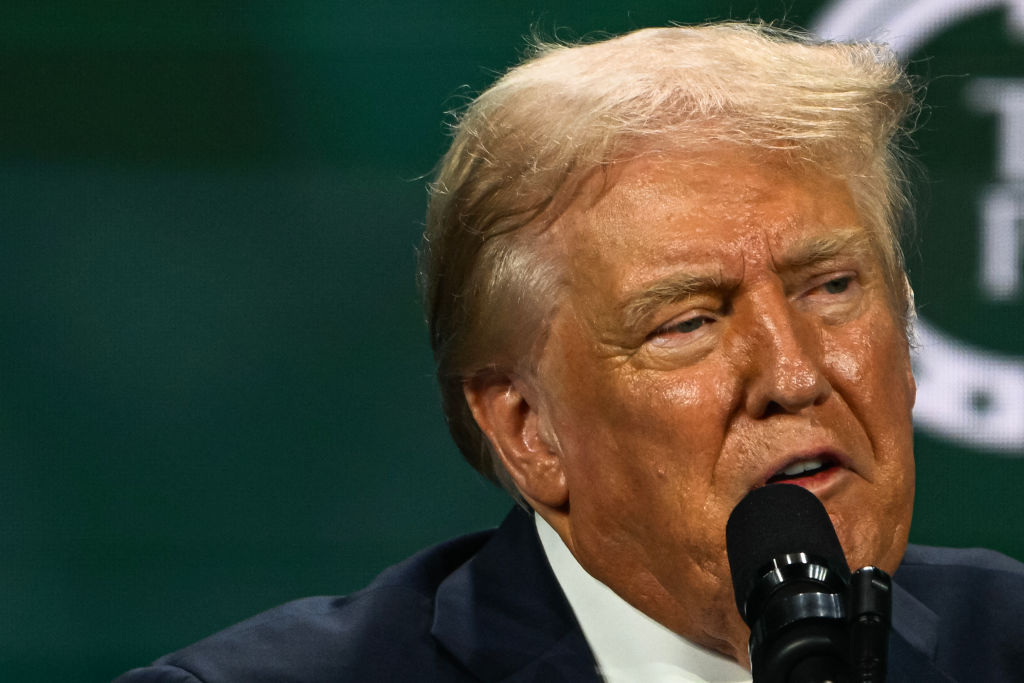
President Donald Trump is celebrating what he calls America’s “best poverty numbers ever,” but his unusual choice of words has sparked reactions across social media.
Speaking to reporters outside the White House on Sunday before traveling to Illinois for the Presidents Cup golf tournament, Trump touted the country’s economic performance.
“We have the best, uh, I guess you could say poverty. They talk poverty,” he said.
The president continued, “We have the best poverty numbers ever in the history of our country. In other words, there’s less poverty now than at any time in the history of our country.”
His comments followed a Truth Social post declaring that his administration had achieved “the BEST FINANCIAL NUMBERS EVER.”
Trump: "We have the best, uhh, I guess you could say poverty. They talk poverty. We have the best poverty numbers ever in the history of our country." pic.twitter.com/W3cKHR8ReZ
— Aaron Rupar (@atrupar) September 27, 2026
While the U.S. poverty rate reached a record low of 10.2% in 2025, the Census Bureau measures poverty using pretax income and household size. Still, that calculation does not fully capture the financial pressure Americans face when paying for basic necessities.
Iowa farmer is paying $75,000 more every month for diesel:
— FactPost (@factpostnews) September 22, 2026
I just wish they would get that deal settled over in the Middle East. We can't handle 2 or 3 more months. The trickle-down effect is tremendous. pic.twitter.com/3UpnRd0mHR
A SmartAsset study estimated that a single adult in New York City needed nearly $159,000 annually to live comfortably, almost double the city’s median household income of $86,900. Even in Texas, where living expenses are generally lower, the estimated $90,771 needed for a comfortable lifestyle exceeded the state’s median household income of $78,476. The figures illustrate how Americans can earn above the federal poverty line while still struggling to keep up with everyday expenses.
#BREAKING: Struggling MAGA senior voter: I actually have panic attacks. I’ve heard a couple this past week, and I get very emotional over it. I don’t want to work anymore, but I can’t afford to retire…It’s not an overnight thing, but it’s been two years now. You said you’d bring… pic.twitter.com/r4T2lf8f3Q
— Emoluments Clause (@Emolclause) June 12, 2026
Experts also warn that reductions in Medicaid and food assistance could affect financially vulnerable families. The supplemental poverty rate, which accounts for government assistance and household expenses, remained essentially unchanged at 13.1% in 2025.
